American Business covers how companies are built, funded, and held to account — free enterprise, financial statements, capital, insurance, ethics, and the laws that govern the workplace. Requirement 5 asks you to take one real business and trace all five primary areas through it, so pick a company you can actually find information about.
Key Requirements Covered:
- Free Enterprise & Labor
- Financial Statements & Capital
- Ethics & Corporate Governance
- Real-World Business Operations
This badge is built around three groups you choose yourself — one of them your own. The work is mostly getting out and meeting people: a festival, a place of worship, a conversation with someone who can tell you what their traditions actually mean. Pick your three groups first, because requirements 1, 2, and 3 all depend on them.
Key Requirements Covered:
- Cultural Community Engagement
- Historical Perspectives
- Traditions & Customs
- Contributions to American Society
American Heritage starts with the Declaration of Independence in your own words and ends with your own family's story. In between you will choose from interviews, local history, film, biography, and song. Several requirements need a counselor's approval before you start — read ahead so you are not halfway into a project that has to be redone.
Key Requirements Covered:
- Declaration of Independence & Liberty
- Local & Family History
- National Symbols & Historical Figures
- Historical Preservation & Careers
This badge was called Indian Lore until recently — it is now American Indian Culture, and its requirements were revised for 2026. You will study the cultural areas, research one tribe, group, or nation in depth, learn some of a language, and either visit a museum or attend a contemporary gathering. Note the word contemporary: these are living cultures, not history.
Key Requirements Covered:
- Tribal Cultural Areas
- Tribal Research & Governance
- Indigenous Language & Place Names
- Living Traditions & Contemporary Gatherings
American Labor is about the people who do the work and the arrangements that govern it — unions, bargaining, grievances, strikes, globalization, and the tradeoffs between owners, workers, and the public. Requirement 7 asks you to argue both sides of a live issue, which is the heart of the badge: you have to make the strongest case for a position before you decide what you think.
Key Requirements Covered:
- Worker Concerns & Fair Labor
- Union History & Collective Bargaining
- Labor Law & Dispute Resolution
- Global Trade & Workplace Trends
Animal Science covers breeds, diseases, digestion, and management across seven kinds of livestock — then asks you to go deep on one. Requirement 6 has six options (beef, dairy, horse, sheep or goat, hog, avian) and you complete only ONE. Read all six before you start; several involve a farm visit or raising an animal, so pick the one you can actually arrange.
Key Requirements Covered:
- Livestock Breeds & Anatomy
- Animal Digestion & Nutrition
- Disease Prevention & Health
- Livestock Management & Agriscience
Animation is a making badge. Most of it is requirement 3, where you plan and build two animations using two different techniques — flipbook, stop motion, cutout, sand, software, whatever you and your counselor agree on. The 12 principles in requirement 2 are the vocabulary professionals use to say why an animation reads as believable, so learn them before you animate, not after.
Key Requirements Covered:
- Principles of Animation
- Storyboarding & Concept Development
- Hands-On Animation Production
- Digital Animation Technology & Careers
Archaeology is the study of people through what they left behind — and its first lesson is that context matters more than objects. A pot dug up and pocketed tells you almost nothing; the same pot recorded in place tells you who lived there and when. Requirements 10 and 11 both need a qualified archaeologist, so line that up early.
Key Requirements Covered:
- Archaeological Methods & Dating
- Artifact Analysis & Preservation
- Antiquities Law & Cultural Ethics
- Fieldwork, Digs & Site Protection
Archery is mostly done on a range, under a certified instructor. Requirement 5 is where the badge is won or lost: you pick recurve/longbow or compound, learn the 11 Steps of Shooting, and then post a qualifying score. Bring this sheet to the range and record scores as you shoot — reconstructing an end from memory afterward does not work.
Key Requirements Covered:
- Archery Safety & Range Rules
- Bow & Arrow Anatomy & Maintenance
- Shooting Technique & Proper Form
- Scored Qualifying Rounds
Architecture asks you to look at buildings the way an architect does — why this material, why this shape, why here. Requirement 4 is the one that takes real care: an accurately scaled floor plan of a room you know, drawn at a quarter inch to the foot. Measure twice. Requirement 3 needs an architect, so arrange that early.
Key Requirements Covered:
- Architectural Styles & Site Planning
- Sustainable Design & Green Materials
- Zoning, Accessibility & Building Codes
- Scaled Floor Plans & Model Drafting
Art is a doing badge with a vocabulary attached. Requirements 2 and 3 give you the language — the elements of art and the principles of design — and requirement 4 makes you render the same subject four different ways, which teaches more about a medium than any amount of reading. Keep your work: your counselor will want to see it.
Key Requirements Covered:
- Design Elements & Color Theory
- Multi-Medium Art Creation
- Visual Communication & Storytelling
- Art History, Museums & Careers
Artificial Intelligence is one of the newest badges, and it has no pamphlet — Scouting America built it around a chatbot called Scoutly instead. Two requirements (2d and 4b) are games you play with your counselor, so they cannot be done alone at a desk. The ethics requirement asks you to write your own guidelines for using AI, which is the most useful thing on this sheet.
Key Requirements Covered:
- Machine Learning & Neural Networks
- AI Applications & Automation
- Deepfakes & Algorithmic Bias
- Ethics & Guidelines for AI
Astronomy cannot be finished in a weekend. Requirement 4 wants the Big Dipper or Cassiopeia sketched hours apart, requirement 6 wants the Moon on four nights in a week, and requirement 5 wants a planet chart covering the next 12 months. Start the observations early and record the date and time on every sketch — that detail is part of the requirement, not a nicety.
Key Requirements Covered:
- Night Sky Navigation & Constellations
- Telescopes & Optical Instruments
- Planetary Motion, Moon & Sun
- Cosmology, Stars & Space Science
Athletics is about training your body on purpose. You will pick an activity, build a program around it, stick with it for three months, and measure what changed. Along the way you will learn how to stay out of the athletic trainer's room, what a balanced diet actually looks like, and why sportsmanship matters more than the score.
Key Requirements Covered:
- Conditioning & Injury Prevention
- Sportsmanship & Athletic Rules
- Training Plans & Fitness Tracking
- Competitive Event Assessment
Automotive Maintenance is hands-on: you will be under the hood checking fluids, belts, fuses, and brakes on a real vehicle. You need access to a car or truck and its owner's manual before you start. Much of the badge is about knowing what the dashboard is telling you and what the manual already says — two things most drivers never learn.
Key Requirements Covered:
- Shop Safety & Basic Tools
- Engine Systems & Fluid Maintenance
- Tires, Brakes & Suspension
- Electrical Systems & Diagnostic Checks
Aviation runs from why a wing lifts to what it takes to hold a pilot certificate. Requirement 2 asks you to build and fly something — a paper FPG-9, a rubber-band balsa plane, or a powered model or drone (which needs TRUST certification). Requirements 3 and 4 involve visits and flights that take arranging, so read ahead and book early.
Key Requirements Covered:
- Four Forces of Flight & Aerodynamics
- Aircraft Instruments & Flight Controls
- Airports, Navigation & Air Traffic Control
- Flight Planning & Aviation Careers
Backpacking is one of Scouting’s most demanding and rewarding badges. You will learn what equipment to carry and how to keep weight down, how to navigate with topographic maps and compass, cook on backcountry stoves, and minimize your impact under Leave No Trace. To earn it, you will plan and carry your pack on three 3-day, 15-mile treks, plus a capstone 5-day, 30-mile trek with a service project and daily journal.
Key Requirements Covered:
- Trail Planning & Gear Selection
- Leave No Trace & Campcraft
- Trail Health, Water & Nutrition
- Multi-Day Trekking & Backcountry Logging
Basketry is an ancient, hands-on craft that turns reed, cane, and splint into useful, durable containers and seats. You will learn the hazards and first aid for sharp hand tools, explore the four fundamental basket styles and different weaving patterns, and then weave three real projects: a square basket, a round basket, and a woven campstool seat.
Key Requirements Covered:
- Basketry Materials & Preparation
- Round & Square Basket Weaving
- Ribbed Basket Construction
- Cane Seat Weaving & Finishing
Bird Study opens your eyes and ears to the wild species all around you. You will learn to recognize birds by silhouette, field marks, flight, and song, practice using optics and field guides, and maintain a 20-species field notebook. Along the way you will explore evolutionary adaptations, conservation challenges for threatened and migratory species, and hands-on projects like nest boxes and bird counts.
Key Requirements Covered:
- Bird Identification by Sight & Sound
- Field Observation & Logging
- Bird Anatomy & Ecological Adaptations
- Avian Habitats & Bird Conservation
Bugling is one of Scouting’s oldest traditions, giving voice to the daily rhythm of camp life from Reveille to Taps. You will learn the history and acoustic physics of the instrument, compose an original call for your unit, master and sound 10 official calls, and serve as your troop's bugler for three months.
Key Requirements Covered:
- Bugle History & Brass Maintenance
- Embouchure & Playing Technique
- Official Military & Scout Bugle Calls
- Ceremonial Troop Performance
Camping is the big one — twenty nights under the sky, and a long list of skills to go with them. Most of this badge cannot be done at a table: you plan the trek, pack the pack, pitch the tent, cook the meal, and log the nights as you go. Start the night log early and keep it honest; it is the part Scouts most often wish they had written down at the time.
Key Requirements Covered:
- Camp Safety & Severe Weather
- Leave No Trace & Site Selection
- Camp Kitchen, Cooking & Sanitary Care
- Expedition Planning & Twenty Camping Nights
Canoeing teaches you to master one of history’s most versatile watercraft. You will learn water safety under Scouting America Safety Afloat, understand canoe design and paddle mechanics, and demonstrate self-rescues, swamped canoe recoveries, and throw-bag rescues. On the water, you and a partner will execute a full repertoire of strokes, pivots, sideslips, and course maneuvers.
Key Requirements Covered:
- Boating Safety & Life Jacket Protocols
- Canoe Equipment & Carrying Methods
- Paddling Strokes & Tandem Navigation
- Swamped Canoe Recovery & Self-Rescue
Chemistry explores how substances interact, transform, and power our modern world. In this badge you will investigate Safety Data Sheets and lab safety, explore the chemistry behind wound care, cooking, and camping gear, experiment with indicators, flame tests, and polymers, and learn how chemists protect the environment and develop sustainable materials.
Key Requirements Covered:
- Laboratory Safety & Chemical Handling
- Periodic Table & Chemical Bonding
- Reactions, Acids, Bases & Solutions
- Industrial Chemistry & Green Science
Chess is among the oldest board games in the world, combining deep calculation, pattern recognition, and long-range strategy. In this badge you will master the rules, notation, and tactics that govern the board, teach another person using the EDGE method, solve checkmate puzzles, and test your skills in tournament play or across the board with your counselor.
Key Requirements Covered:
- Chess Rules & Board Setup
- Tactical Motifs: Pins, Forks & Skewers
- Opening Principles & Endgame Strategy
- Tournament Notation & Match Play
Citizenship in Society focuses on ethical leadership, self-reflection, and what it means to create communities where all people feel respected, heard, and welcomed. Through thoughtful discussions with your counselor and peers, you will explore real-world scenarios, examine personal values in light of the Scout Oath and Law, and practice standing up for others as an active upstander.
Key Requirements Covered:
- Personal Identity & Empathy
- Diversity, Equity & Inclusion
- Constructive Dialogue & Upstander Action
- Inclusive Leadership & Community Service
Citizenship in the Community invites you to explore the local roots of democracy and civic responsibility. You will map key community facilities, chart your municipal government structure, attend a public council meeting, interview a local official, complete eight hours of volunteer service for a local charity, and present a multimedia portrait of your hometown's heritage, people, and future.
Key Requirements Covered:
- Local Government Structure & Services
- Public Council Meeting Participation
- Civic Service Project Execution
- Community Issues & Hometown Presentation
Citizenship in the Nation guides you through the founding documents, constitutional principles, and civic structures that unite the United States. You will analyze the Constitution, the Bill of Rights, and historic speeches, follow national news, visit national landmarks or federal facilities, and communicate directly with your members of Congress on issues that matter to you.
Key Requirements Covered:
- U.S. Constitution & Bill of Rights
- Three Branches of Federal Government
- National Historic Landmarks & Heritage
- Active Citizenship & National Issues
Citizenship in the World expands your horizons beyond national borders. You will explore how nations interact through international law, trade, and diplomacy, examine differing forms of government across the globe, investigate major humanitarian organizations like the UN, WHO, and Red Cross, and discover what it means to be an engaged, responsible global citizen.
Key Requirements Covered:
- International Law & Global Treaties
- Comparative Forms of Government
- Diplomatic Relations & Foreign Policy
- Global Humanitarian Organizations
Climbing challenges your balance, agility, and mental focus while immersing you in the vertical world. You will master Climb On Safely standards, wilderness first aid, crag ethics under Leave No Trace, essential climbing knots and rope care, harness and belay mechanics, verbal command systems, and active climbing, belaying, and rappelling on rock faces or climbing walls.
Key Requirements Covered:
- Vertical Safety & Belay Communication
- Climbing Knots, Harnesses & Gear Care
- Top-Rope Climbing & Movement Technique
- Rappelling, Anchoring & Rope Management
Coin Collecting introduces you to numismatics—the study and collecting of coins, tokens, and paper money. You will explore how coins and currency are manufactured at U.S. Mint and BEP facilities, learn professional grading and preservation techniques, assemble modern denomination sets (including Lincoln cents, Jefferson nickels, State and American Women quarters, and dollar coins), and study world coins or attend a numismatic show.
Key Requirements Covered:
- Coin Anatomy & Minting Technology
- Coin Grading & Preservation
- U.S. Mint Marks & Coinage History
- Building & Housing a Coin Collection
Collections celebrates the thrill of discovering, cataloging, preserving, and sharing items you love—from sports memorabilia and comics to natural minerals, vinyl records, and toys. You will master archival preservation and display techniques, build a structured catalog system, analyze valuation and hobby economics, and explore careers in museum curation, archiving, and appraisal.
Key Requirements Covered:
- Collector Principles & Ethics
- Cataloging & Provenance Tracking
- Safe Preservation, Storage & Care
- Exhibition, Display & Valuation
Communication is essential to leadership, teamwork, and lifelong success. In this Eagle-required badge, you will analyze your personal communication and listening habits, write and deliver a formal five-minute speech, interview an expert, report objectively on a public meeting, teach a skill using the EDGE method, create digital or print publications, and serve as master of ceremonies for a major unit event.
Key Requirements Covered:
- Public Speaking & Presentation Skills
- Interviews & Active Listening
- Meeting Leadership & Parliamentary Order
- Digital Communication & Community Outreach
Competitive Gaming explores the fast-growing world of video games and esports. You will examine the history of gaming from early arcade cabinets to global arenas, apply the Scout Oath and Law to digital communities to counter toxicity, maintain balanced screen-time, sleep, and physical fitness habits, build a custom gaming PC parts list, and explore collegiate esports and careers across game development and broadcast production.
Key Requirements Covered:
- Ergonomics, Nutrition & Healthy Gaming
- Sportsmanship & Online Code of Conduct
- Team Strategy, Communication & Review
- Esports Tournament Management & Careers
Composite Materials explores the engineering of high-performance engineered materials made from fibers and resin matrices—used in aerospace, high-speed racing, prosthetics, and sporting goods. You will learn lab safety and SDS management, compare composites with metals and wood, analyze reinforcements like carbon fiber and fiberglass, formulate thermoset and thermoplastic resins, and lay up two custom composite projects.
Key Requirements Covered:
- Resin Matrices & Reinforcing Fibers
- Safety, Ventilation & Curing Chemistry
- Lamination & Vacuum Bagging Techniques
- Fabricating Functional Composite Parts
Cooking is an Eagle-required badge about nourishing yourself, your family, and your patrol safely and well. You will master food safety and nutrition guidelines, plan balanced multi-day menus, cook meals at home, outdoors at camp, and on the trail using a wide variety of cooking methods, and learn to manage time, budgets, and clean-up.
Key Requirements Covered:
- Food Safety, Sanitation & Cross-Contamination
- Nutritional Planning & Balanced Menus
- Camp & Trail Cooking Techniques
- Kitchen Budgeting, Cooking & Clean-up
Crime Prevention teaches how laws protect communities and how individuals, families, and neighborhoods work together to prevent crime. You will study why people commit crimes, conduct a physical security survey of a home or facility, teach personal protection using the EDGE method, examine retail loss prevention and online scams, and interview a law enforcement officer or civil servant.
Key Requirements Covered:
- Home Security & Risk Assessment
- Community Policing & Neighborhood Watch
- Cybercrime Prevention & Identity Theft
- Law Enforcement Careers & Crime Analysis
Cybersecurity is about safeguarding devices, personal data, and critical networks in an interconnected world. You will explore digital footprints and cyber ethics through the Scout Law, examine the CIA Triad and real-world attack vectors, implement robust defenses like MFA and cryptography, evaluate IoT risks, and take part in hands-on activities or competitions.
Key Requirements Covered:
- Threat Vectors, Malware & Social Engineering
- Cryptography, Encryption & Hashing
- Network Security Auditing & Defense
- Digital Privacy & Cybersecurity Careers
Cycling is an Eagle-required badge about fitness, self-reliance, and the freedom of two wheels. You will learn traffic laws and bike handling skills, perform regular safety checks and mechanical maintenance, and complete a progressive series of endurance rides — either on paved roads culminating in a 50-mile road tour, or on trails culminating in a 22-mile mountain bike trip.
Key Requirements Covered:
- Bicycle Maintenance & Roadside Repairs
- Traffic Laws, Signals & Helmet Safety
- Cycling Conditioning & Ergonomics
- Long-Distance Endurance Rides
Dentistry explores oral health, tooth anatomy, and the science of preventing decay and gum disease. You will study dental X-rays, diagram molar structures and nerve pathways, learn emergency first aid for a knocked-out tooth, tour a dental office to observe checkups and plaque control, explore fluorides and diet, create dental education projects, and research careers across oral medicine.
Key Requirements Covered:
- Dental Anatomy & Tooth Structure
- Preventive Oral Hygiene & Nutrition
- Dental Instruments, X-Rays & Restorations
- Dental Specialties & Clinical Careers
Digital Technology explores how computers, mobile devices, and networks shape our modern world. You will trace the evolution of digital devices, learn how sound, images, and text are encoded as binary data, compare compression and network architectures, complete three hands-on digital projects (spreadsheets, graphic design, audio, presentations, blogs, or web pages), investigate intellectual property protections, and practice responsible electronic waste recycling.
Key Requirements Covered:
- Hardware Components & Microprocessors
- Data Transmission & Networking Protocols
- Software Copyright & Digital Ethics
- Digital Innovation & Systems Engineering
Disabilities Awareness promotes understanding, inclusion, and equal access for people with physical, sensory, intellectual, and invisible disabilities. You will learn person-first language and etiquette, visit a service agency, explore adaptive sports and assistive technologies, evaluate physical accessibility and invisible disability accommodations at two community sites, participate in advocacy or education, and make a personal commitment to building a more inclusive world.
Key Requirements Covered:
- Disability Rights & ADA Regulations
- Accessibility Audits & Barrier Removal
- Assistive Devices & Adaptive Technology
- Inclusive Volunteering & Advocacy
Dog Care teaches the responsibility, dedication, and knowledge required to keep a canine companion healthy, safe, and well-trained. You will explore dog history and breed groups, learn canine anatomy and obedience training commands, keep a detailed two-month daily care and weight log, learn emergency first aid and parasite control, visit a veterinary clinic or shelter, and understand local pet ordinances.
Key Requirements Covered:
- Canine Nutrition & Daily Care
- Obedience Training & Behavior
- Veterinary Health & Vaccination Schedules
- Local Animal Control & Breed Identification
Drafting is the universal technical language of design, architecture, engineering, and manufacturing. You will format drawing paper with title blocks and Gothic lettering, produce scale drawings manually with drafting instruments and digitally using Computer-Aided Design (CAD) software, execute redline engineering revisions, compare manual and digital workflows, and investigate drafting tools, industry practices, and careers.
Key Requirements Covered:
- Drafting Tools & Standard Scales
- Orthographic Projection & Dimensioning
- Architectural & Engineering Drawings
- Computer-Aided Design (CAD) Modeling
Electricity explores the physical forces and systems that power modern society. You will learn essential electrical emergency response protocols, conduct a home electrical safety audit, construct an electromagnet, diagram how batteries and electric bells work, calculate circuit loads and prevent overloads, read electric meters and bills, wire circuits and switches, and explore careers across the electrical industry.
Key Requirements Covered:
- Electrical Safety & Shock Prevention
- Ohm’s Law, Voltage, Current & Resistance
- Series & Parallel Circuit Construction
- Residential Wiring, Breakers & Transformers
Electronics explores the components, circuits, and control systems that make modern technology work. You will learn workshop and electrical safety, draw schematic diagrams using standard component symbols, master soldering and desoldering techniques, explore digital logic and binary numbers, build an operational control, digital, or analog project, use diagnostic test equipment with Ohm's law, and explore electronics careers.
Key Requirements Covered:
- Soldering Safety & Component Assembly
- Schematic Diagrams & Circuit Symbols
- Multimeter & Oscilloscope Testing
- Semiconductors, Microchips & Project Build
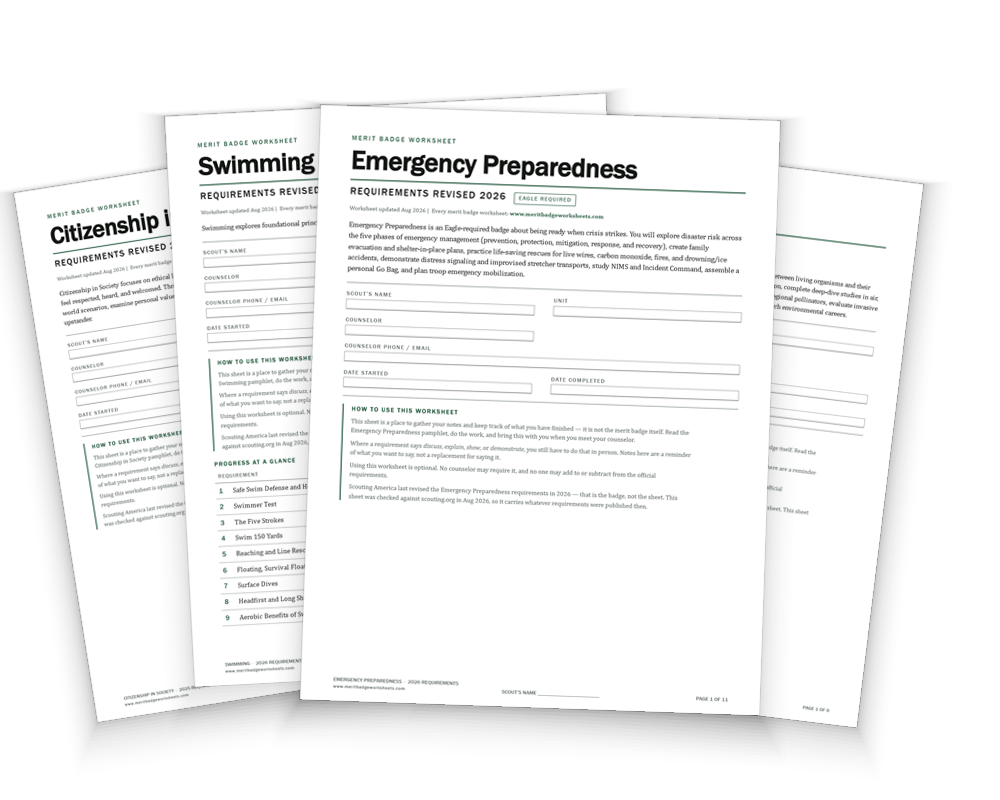
Emergency Preparedness is an Eagle-required badge about being ready when crisis strikes. You will explore disaster risk across the five phases of emergency management (prevention, protection, mitigation, response, and recovery), create family evacuation and shelter-in-place plans, practice life-saving rescues for live wires, carbon monoxide, fires, and drowning/ice accidents, demonstrate distress signaling and improvised stretcher transports, study NIMS and Incident Command, assemble a personal Go Bag, and plan troop emergency mobilization.
Key Requirements Covered:
- Prevention & Risk Assessment
- Family & Troop Disaster Action Plans
- Incident Command & Multi-Agency Response
- Crisis Simulation, Triage & Recovery
Energy powers every aspect of human civilization and the natural environment. You will explore forms of energy and thermodynamic conversions, construct a multi-stage energy conversion system, analyze system efficiency and energy losses, conduct a 14-day home energy audit, investigate energy waste and conservation trade-offs, construct national and global energy data charts, evaluate five advanced energy systems, and research careers in the energy sector.
Key Requirements Covered:
- Forms of Energy & Conservation Laws
- Home Energy Auditing & Efficiency
- Fossil Fuels vs. Renewable Resources
- Power Generation, Grids & Future Technologies
Engineering is the creative application of science and mathematics to design practical solutions that improve human life. You will investigate how a manufactured home appliance operates, research historic engineering achievements, explore six engineering disciplines, interview a practicing engineer, apply the systems engineering design cycle to create an original device, complete two hands-on engineering experiments, study the Professional Engineer (P.E.) credential and Code of Ethics, and explore engineering careers.
Key Requirements Covered:
- Engineering Design Process & Methods
- Disciplines of Modern Engineering
- Structural Prototyping & Stress Testing
- Engineering Ethics & Society Impact
Entrepreneurship explores how enterprising individuals turn ideas into viable businesses. You will define the role of entrepreneurs in the economy, analyze key entrepreneurial skills, interview a practicing business founder, brainstorm and pitch new business concepts, write a detailed 5-part business plan (product, market analysis, finances, personnel, and marketing with flyer design), and evaluate operations, risk management, and ethics.
Key Requirements Covered:
- Ideation & Market Opportunity Analysis
- Business Plan Formulation & Budgeting
- Marketing, Branding & Customer Service
- Enterprise Launch & Risk Management
Environmental Science is an Eagle-required badge that explores the complex interactions between living organisms and their environment. You will define environmental science, conduct a 2-day ecosystem observation, complete deep-dive studies in air, water, and land pollution, investigate endangered species and pollution prevention, study regional pollinators, evaluate invasive species, prepare an environmental impact assessment for a construction project, and research environmental careers.
Key Requirements Covered:
- Ecology & Ecosystem Interactions
- Pollution Monitoring: Air, Water & Soil
- Field Studies & Biodiversity Sampling
- Environmental Impact Analysis & Conservation
Exploration is the pursuit of discovery through rigorous, purposeful scientific field and laboratory investigation. You will learn how exploration differs from recreational adventure travel, examine the history and impact of exploration across major scientific fields, study active expeditions, plan a complete expedition using the 8-step planning cycle, prepare gear and conduct a pre-expedition SAFE check, undertake an actual field expedition applying Leave No Trace and outdoor ethics, compile a formal post-expedition report, and explore careers in exploration.
Key Requirements Covered:
- History & Ethics of Scientific Exploration
- Expedition Planning, Logistics & Safety
- Navigation, Field Science & Data Collection
- Expedition Execution & Fieldwork Reporting
Family Life is an Eagle-required badge focusing on fostering healthy, supportive, and communicative family relationships. You will explore what makes a family vital to society, reflect on your personal role within your household, maintain a 90-day record of at least five regular home chores, plan and execute both an individual home project and a collaborative family project, facilitate structured family meetings addressing real-world challenges, finances, and etiquette, and reflect on effective parenting.
Key Requirements Covered:
- Family Meetings & Communication
- 90-Day Chore Tracking & Accountability
- Home Improvement Project Leadership
- Family Values, Parenting & Financial Health
Farm Mechanics teaches the maintenance, troubleshooting, and safe repair of agricultural machinery and power systems. You will learn farm shop safety rules and PPE, design a farm shop floor plan with safety equipment, interpret warning symbols and Safety Data Sheets (SDS), study power transmission in diesel engines and hydraulics, dress hand tools and repair handles, perform engine service or preoperational inspections, interview an implement service technician, and explore agricultural mechanics careers.
Key Requirements Covered:
- Farm Equipment Safety & Power Take-Off
- Internal Combustion Engine Maintenance
- Hydraulic, Fuel & Transmission Systems
- Welding & Machinery Repair on the Farm
Fingerprinting explores the scientific principles and practical techniques of biometric identification. You will learn the history of fingerprinting, contrast civil and criminal identification, compare AFIS law enforcement databases with biometric access systems, examine friction ridge anatomy, record clear rolled and plain fingerprint impressions, identify the three major pattern families (loops, whorls, and arches), and explore careers in forensic science and biometrics.
Key Requirements Covered:
- Friction Ridge Anatomy & History
- Loop, Whorl & Arch Pattern Classification
- Fingerprint Inking & Card Technique
- Automated Biometric Systems & Forensics
Fire Safety covers the science of fire, proactive prevention, and rapid response in homes, public facilities, and the backcountry. You will explore the chemistry of the fire tetrahedron and heat transfer, practice extinguisher classes and techniques, master burn injury first aid and alarm maintenance, conduct a home safety audit and family fire drill, handle flammable liquids, practice campfire safety and Leave No Trace, teach a fire skill using the EDGE method, study wildland fires, and tour a fire station or research fire service careers.
Key Requirements Covered:
- Fire Chemistry & Prevention Strategies
- Home Fire Drills & Smoke Detectors
- Fire Extinguisher Selection & Operation
- Fire Service Operations & Emergency Tactics
First Aid is an Eagle-required badge that equips Scouts with critical life-saving skills for acute illness, trauma, and wilderness emergencies. You will learn scene safety, primary patient assessment, triage, and shock management; assemble and inspect personal and troop first-aid kits; master care for non-bleeding and bleeding wounds; respond to breathing emergencies, unconsciousness, cardiac arrest, CPR, and AED deployment; demonstrate bandages and splints for fractures; manage spinal precautions and patient carries; treat thermal extremes and mental health crises; teach a first-aid skill using the EDGE method; and explore emergency medical careers.
Key Requirements Covered:
- Scene Assessment, Triage & Shock Treatment
- Bleeding Control, Bandaging & Splinting
- CPR, AED & Breathing Emergencies
- Thermal Extremes, Patient Carries & EMS
Fish and Wildlife Management explores the science of conserving animal populations and preserving aquatic and terrestrial habitats. You will study state conservation practices and ecological threats, build nest boxes, bird feeders, or wildlife blinds, observe and catalog 25 native species, conduct a fishery survey or set up a native aquarium, and research career paths in wildlife biology and natural resources management.
Key Requirements Covered:
- Ecology & Population Carrying Capacity
- Aquatic Habitat Surveying & Hatcheries
- Game Management & Wildlife Refuges
- Conservation Law & Wildlife Biology Careers
Fishing combines aquatic science, equipment mastery, knot-tying dexterity, and ethical sportsmanship. You will explore fishing safety hazards and hook removal, compare rod-and-reel outfits, demonstrate casting methods, tie five essential fishing knots, identify artificial lures and natural baits, apply Leave No Trace and catch-and-release ethics, review state game regulations, catch and identify a wild fish, and clean and cook your catch.
Key Requirements Covered:
- Tackle Selection, Knots & Rigging
- Casting Accuracy & Fishing Techniques
- Catch-and-Release & Fishery Regulations
- Catch Preparation, Cleaning & Cooking
Fly Fishing blends precision casting, aquatic entomology, fly tying artistry, and river conservation. You will learn cold-water safety and hook extraction, balance a fly rod-line-leader outfit, tie 5 essential rigging knots (arbor, nail, loop-to-loop, surgeon's, improved clinch), tie and fish with artificial flies (dry, wet, nymph, streamer, popper, saltwater), demonstrate 30-foot overhead and roll casts, match the hatch, practice Leave No Trace catch-and-release ethics, review local game regulations, catch a wild fish on a fly, and clean and cook a fish.
Key Requirements Covered:
- Fly Gear Anatomy & Leader Rigging
- Artificial Fly Tying & Aquatic Hatches
- Roll & Overhead Casting Techniques
- Stream Reading, Safety & Conservation
Forestry explores the science, sustainable management, and ecology of forest ecosystems. You will build a 15-species field notebook, examine wood specimens, growth rings, or pest damage, evaluate 8 ecological and economic forest benefits, study silvicultural systems and prescribed burning, tour a managed forest, sawmill, or manufacturing plant, conduct a hazard tree inventory, analyze 5 threats to forest health, and explore professional forestry careers.
Key Requirements Covered:
- Tree Identification & Forest Ecology
- Timber Stand Measurement & Clinometers
- Wildfire Prevention & Forest Health
- Sustainable Silviculture & Urban Forestry
Game Design teaches how rules, mechanics, and thematic elements combine to create engaging interactive experiences. You will analyze four games across different mediums, evaluate play value concepts, explore game terminology, study intellectual property and licensing, modify existing game rules to observe player dynamics, design and write rules for an original game, build and iteratively playtest a prototype, conduct a blind playtest, and interview an industry or educational professional.
Key Requirements Covered:
- Game Mechanics, Balance & Player Agency
- Rulebook Writing & Thematic Design
- Prototyping & Game Development
- Iterative Playtesting & Feedback Analysis
Gardening teaches the botany, horticulture, soil science, and ecological care needed to cultivate healthy plants and food. You will learn garden safety and chemical handling, grow 6 vegetables and 6 flowers from seeds and seedlings through harvest/flowering, analyze the nutritional value of produce, perform a 100-seed germination test, visit an agricultural institution or botanical garden, examine pollinator ecology, control pests using organic methods, maintain a 90-day garden or compost project, and explore careers in horticulture.
Key Requirements Covered:
- Soil Preparation, Testing & Composting
- Seed Germination & Transplanting
- Pest Management & Companion Planting
- Harvesting, Storage & Culinary Use
Genealogy is the exploration of family lineages, ancestral heritage, and historical documentation. You will master genealogical terminology, create a timeline biography or keep a 6-week journal, interview a relative, examine physical and digital records, locate primary vital documents, contact a genealogical repository or lineage society, chart a 3-generation pedigree tree, complete 2 family group records, analyze the impact of computing, photography, and indexing, and reflect on what you discovered about your family history.
Key Requirements Covered:
- Pedigree Charts & Family Tree Mapping
- Primary Sources: Census & Vital Records
- Oral History & Relative Interviews
- Genetic Genealogy & Historical Archives
Geocaching blends outdoor wilderness navigation, GPS technology, and high-tech treasure hunting. You will examine outdoor safety hazards and GPS planning, explore cache etiquette and Leave No Trace principles, master GPS constellation theory and EDGE unit operation, integrate map and compass skills, locate online public caches and find a physical cache in the field, explore Cache to Eagle / Travel Bugs / CITO projects, and design and execute a multi-waypoint geohunt event.
Key Requirements Covered:
- GPS Receiver Operation & Coordinates
- Geocache Navigation & Etiquette
- Cache In Trash Out (CITO) Stewardship
- Hiding & Maintaining an Original Cache
Geology investigates Earth's structure, rock cycles, dynamic plate tectonics, valuable energy and mineral resources, and the deep history of prehistoric life. You will explore rock formations, mineral extraction, geologic maps, choose one of four deep-dive focus areas (Surface and Sedimentary Processes, Energy Resources, Mineral Resources, or Earth History and Paleontology), practice Leave No Trace ethical specimen collection, and research geoscience careers.
Key Requirements Covered:
- Mineral Identification & Hardness Tests
- Rock Cycle: Igneous, Sedimentary & Metamorphic
- Plate Tectonics, Earthquakes & Volcanoes
- Geologic Maps, Energy Resources & Fossils
Golf teaches the rules, etiquette, mechanics, conditioning, and sportsmanship of both traditional golf and disc golf. You will master golf course safety and first aid, then select either Option A (Traditional Golf: USGA Rules of Golf, World Handicap System, golf history, swing fundamentals, driving, fairway, iron, bunker, and putting shots, playing 18 holes, and golf careers) or Option B (Disc Golf: PDGA Official Rules, scoring, disc design history, X-step runup, backhand/forehand/overhand/roller throws, putting stances, playing 18 holes, and careers).
Key Requirements Covered:
- Golf Etiquette, Rules & Course Safety
- Club Anatomy & Proper Grip Mechanics
- Short Game: Putting, Chipping & Sand Play
- Full Swing Mechanics & Regulation Rounds
Graphic Arts explores visual communication design, typography, prepress technology, modern printing methods, and postpress finishing. You will review five printing processes (offset lithography, screen printing, digital, relief, and gravure), distinguish continuous tone from line art and halftones, design an original printed piece with considered typography and layout, execute a production run, explore postpress finishing and bindery methods, tour a print plant or design school, and research graphic arts careers.
Key Requirements Covered:
- Typography, Layout & Design Principles
- Color Theory & Digital Prepress
- Printing Processes: Offset, Screen & Digital
- Finishing, Binding & Industry Careers
Health Care Professions explores the diverse spectrum of medical, nursing, therapy, and diagnostic careers. You will examine the clinical responsibilities, education, and licensing requirements for 12 health care roles across 4 career groups, conduct an informational interview with a healthcare provider at their workplace, analyze medical ethics and the Physician's Oath, study HIPAA patient privacy laws, evaluate recent medical innovations, and volunteer at a community health event.
Key Requirements Covered:
- Healthcare Specialties & Delivery Systems
- Patient Confidentiality & Medical Ethics
- Clinical Diagnostic Tools & Procedures
- Health Careers & Educational Pathways
Hiking is an Eagle-required badge focusing on endurance, trail safety, meticulous planning, and outdoor ethics. You will learn hiking first aid and footwear selection, practice Leave No Trace principles and the Outdoor Code, design a conditioning plan for distance trekking, prepare written hike plans for five major treks, complete four 10-mile hikes and one 20-mile hike (60 miles total), and compile reflective post-hike reports.
Key Requirements Covered:
- Hiking Gear, Footwear & Blister Care
- Trail Navigation, Maps & Terrain Reading
- Hydration, Energy & Trail First Aid
- Completing Hikes: 5, 10, 15 & 20-Mile Treks
Home Repairs is completely hands-on under adult supervision: you will be patching drywall, weatherstripping, rewiring a lamp plug, and clearing a clogged drain. You need access to a home toolbox and must locate the main water shutoff and electrical breaker box before you begin. Pick tasks from requirements 2 through 6 that match work your home actually needs.
Key Requirements Covered:
- Home Tool Safety & Maintenance
- Plumbing Repairs: Faucets, Toilets & Pipes
- Drywall Patching, Carpentry & Painting
- Electrical Fixtures, Doors & Weatherproofing
Horsemanship is earned in the barn and in the saddle. You will learn equine anatomy, feeding, and the warning signs of colic, plus how to groom, saddle, and bridle safely. Requirement 11 is the riding practical: mounting, walking, trotting, cantering, and backing up with quiet, controlled rein aids on level ground.
Key Requirements Covered:
- Equine Safety, Breeds & Anatomy
- Grooming, Tacking & Hoof Care
- Riding Aids, Mount & Dismount
- Arena Riding: Walk, Trot & Canter Control
Insect Study requires getting into the field with a net or camera. You will observe insect life cycles, examine social colonies like ants or honeybees, and analyze how insects pollinate food crops and recycle nutrients. Requirements 4 and 5 need time outdoors watching live specimens in their natural habitats, so start observing early in the season.
Key Requirements Covered:
- Insect Anatomy & Life Cycles
- Collecting, Curating & Identifying Orders
- Social Insects: Honeybees & Ants
- Ecological Roles: Pollination & Pest Control
Inventing guides you through the process of taking an original idea from a sketch to a working model. You will study patent history, analyze intellectual property, and interview someone who holds a patent. Requirement 7 is the core: designing, building, and testing a real prototype to solve an everyday problem you have identified yourself.
Key Requirements Covered:
- Creative Ideation & Problem Solving
- Prototyping & Iterative Testing
- Patents, Copyrights & Intellectual Property
- Market Feasibility & Invention Pitching
Journalism is about reporting facts accurately on deadline. You choose either print/digital or broadcast journalism, interview real sources, write lead stories, and produce an editorial. Requirement 3 asks you to cover a live event and submit your story for publication in a school, troop, or community outlet.
Key Requirements Covered:
- News Writing & The Inverted Pyramid
- Interviewing Techniques & Fact Checking
- Press Freedom, Libel & Journalism Ethics
- Multi-Platform Publishing & Broadcasting
Kayaking starts on calm water with safety fundamentals and paddle strokes. You must pass the BSA swimmer test before getting afloat. Requirement 6 tests your composure with a controlled capsize, wet exit, and self-rescue in deep water, so bring a towel and be ready to spend real time in the water.
Key Requirements Covered:
- Kayak Safety & Personal Flotation Devices
- Kayak Anatomy & Paddle Selection
- Wet Exits & Paddle-Float Self-Rescue
- Paddling Strokes & Open Water Maneuvering
Landscape Architecture looks at the outdoor spaces where people live, walk, and gather. You will visit a completed project to critique its circulation and plantings, identify native trees and shrubs, and measure an existing site to scale. Requirement 4 requires drafting your own full-scale landscape redesign plan with plant lists and materials.
Key Requirements Covered:
- Site Analysis, Zoning & Topography
- Native Planting & Sustainable Horticulture
- Hardscapes: Walkways, Decks & Irrigation
- Scaled Landscape Architectural Drafting
Law examines how rules are made, interpreted, and enforced to keep society orderly. You will compare civil and criminal proceedings, explore consumer rights, and discuss constitutional landmarks. Requirements 6 and 7 involve visiting a real court session and interviewing a practicing attorney, so arrange those contacts well in advance.
Key Requirements Covered:
- Constitutional Law & Bill of Rights
- Criminal vs. Civil Legal Systems
- Courtroom Procedure & Trial Observation
- Legal Ethics & Legal Profession Careers
Leatherwork is an ancient craft of cutting, carving, and lacing durable hides into functional gear. You will learn the tanning process, safe knife techniques, and leather care. Requirements 3 and 4 require tooling or stamping a project, dyeing it, lacing edges, and braiding an article like a four-strand woggle or lanyard.
Key Requirements Covered:
- Leather Tanning & Material Types
- Tooling, Stamping & Carving Techniques
- Edge Finishing, Lacing & Stitching
- Crafting Finished Functional Leather Projects
Lifesaving requires strong swimming skills and calm judgment under pressure. You must earn the Swimming merit badge before starting. The badge focuses on the rescue order — Reach, Throw, Row, Go — and trains you in defensive releases, underwater approaches, and towing conscious and unconscious subjects without endangering yourself.
Key Requirements Covered:
- Rescue Hierarchy: Reach, Throw, Row, Go
- Swimming Rescues & Defense Escapes
- Towing Carries & In-Water Resuscitation
- Spinal Injury Management in Water
Mammal Study teaches you to read the signs of warm-blooded wildlife in your area. You will classify species, investigate food chains, and study population dynamics. Requirement 3 involves keeping a detailed field notebook over an extended period or conducting a practical conservation project that directly improves mammal habitat.
Key Requirements Covered:
- Mammal Biology & Classification
- Animal Tracking, Scat & Sign Reading
- Field Observation of Mammalian Behavior
- Mammal Conservation & Population Ecology
Metalwork turns raw sheet, rod, and bar stock into durable tools and hardware. You will study work-hardening, annealing, and tempering, then choose one of four distinct disciplines: sheet metal, silversmithing, foundry, or blacksmithing. Each option requires heating, cutting, and shaping real metal into finished items.
Key Requirements Covered:
- Shop Safety & Metallurgy Fundamentals
- Metal Heating, Quenching & Annealing
- Forming: Forging, Casting, or Sheet Metal
- Finished Functional Metalworking Projects
Mining in Society covers the minerals, ores, and energy sources beneath our feet that make modern life possible. You will trace everyday products back to their mined raw materials, explore environmental reclamation, and learn about mine safety. Requirement 5 asks you to visit an operating mine, processing mill, or related geological site.
Key Requirements Covered:
- Mineral Exploration & Geologic Mapping
- Surface vs. Underground Mining Methods
- Mine Safety & Environmental Reclamation
- Mineral Processing & Everyday Uses
Model Design and Building is about turning blueprints and concepts into precise physical scale models. You will plan scale ratios, choose suitable materials, and practice safe cutting and gluing. Requirements 4 and 5 require constructing a detailed scale model — architectural, vehicle, or mechanical — plus an imaginative special-effects piece.
Key Requirements Covered:
- Scale Ratios & Blueprint Interpretation
- Model Materials: Wood, Plastics & Composites
- Precision Cutting, Assembly & Gluing
- Surface Finishing, Painting & Scale Detailing
Motorboating combines mechanical knowledge with on-the-water boat control under Scouting America Safety Afloat. You must pass the BSA swimmer test before handling a boat. Requirement 5 is the practical driving test: leaving a dock, trimming the engine, maneuvering through a slalom course, and performing emergency man-overboard recoveries.
Key Requirements Covered:
- Boating Laws, PFDs & Registration
- Engine Systems, Fuel Safety & Inspection
- Navigation Rules of the Road & Docking
- High-Speed Handling & Emergency Recovery
Moviemaking is a collaborative storytelling badge where you write, shoot, and edit a real motion picture. You will draft a treatment, draw a detailed storyboard, and learn how camera angles, lighting, and sound establish mood. Requirement 3 requires producing a finished 3-to-5-minute film and screening it for your counselor.
Key Requirements Covered:
- Screenwriting & Storyboarding
- Camera Framing, Angles & Lighting
- Directing & Audio Field Recording
- Digital Video Editing & Film Distribution
Multisport introduces you to continuous athletic competition across multiple disciplines — such as triathlon, duathlon, or aquathlon. You will learn injury prevention, nutrition, and transition-area setup. Requirement 5 requires building and following a four-week training plan, followed by participating in a real multi-discipline event.
Key Requirements Covered:
- Multisport Rules & Transition Mechanics
- Endurance Conditioning & Training Regimens
- Sports Nutrition, Hydration & Injury Care
- Completing an Official Triathlon/Duathlon
Music explores the theory, history, and expressive power of rhythm and melody. You will categorize musical instruments, study copyright in the digital era, and analyze live or recorded performances. Requirement 1 asks you to perform a song on an instrument or vocally for an audience, or participate in a musical ensemble for six months.
Key Requirements Covered:
- Music Theory, Notation & Rhythm
- Solo & Ensemble Performance
- Music History & World Genres
- Melodic Composition & Music Careers
Nature takes a broad, ecological look at the living world, connecting plants, soils, and animals into functioning systems. Requirement 4 is the core: you must complete field studies across five distinct natural disciplines — birds, mammals, reptiles, insects, and plants. Expect to spend significant time outdoors observing and cataloging specimens.
Key Requirements Covered:
- Ecosystem Connections & Food Webs
- Plant & Tree Field Identification
- Wildlife Sampling: Birds, Reptiles & Insects
- Habitat Stewardship & Natural Resource Care
Nuclear Science demystifies radiation, atomic structure, and particle physics. You will learn how radiation is detected, calculate half-lives, and evaluate nuclear reactors and medical isotopes. Requirement 4 involves building an operational model such as an electroscope or a cloud chamber to observe radiation tracks firsthand.
Key Requirements Covered:
- Atomic Structure & Particle Physics
- Radiation Detection & Radiation Safety
- Nuclear Fission & Reactor Operations
- Radioisotopes, Medicine & Nuclear Careers
Oceanography studies the 70 percent of Earth covered by seawater — its chemistry, currents, seafloor geology, and marine life. You will explore wave mechanics, underwater topography, and how oceans drive global weather. Requirement 8 asks you to conduct real experiments with seawater salinity and density or visit an oceanographic research vessel.
Key Requirements Covered:
- Ocean Floor Bathymetry & Plate Tectonics
- Seawater Chemistry, Salinity & Currents
- Marine Biology & Coral Reef Ecosystems
- Oceanographic Research Tools & Conservation
Orienteering combines map reading, compass work, and foot racing in unfamiliar terrain. You will set up a pace course, master declination, and interpret intricate contour lines. Requirement 7 is where you prove your skill: successfully navigating at least three competitive or practice orienteering cross-country courses.
Key Requirements Covered:
- Topographic Maps & Contour Lines
- Magnetic Declination & Compass Bearings
- Pacing & Wilderness Route Choice
- Running Scored Orienteering Courses
Painting teaches the craft of preparing, protecting, and finishing interior and exterior surfaces. You will learn about primers, sealers, drying oils, and VOC safety, as well as color harmony on the color wheel. Requirement 3 requires properly preparing and painting two real surfaces — such as wood trim, furniture, or drywall — using brush or roller.
Key Requirements Covered:
- Painting Safety, Ventilation & Scaffolding
- Surface Preparation, Sanding & Priming
- Paint Formulations: Latex vs. Oil Bases
- Brush & Roller Application & Clean-Up
Personal Fitness asks you to look honestly at how you live, measure where you actually are, and then spend twelve weeks changing it. The measuring is the point: you set your own tests with your counselor, record where you start, and prove you improved. Fitness here means more than muscle — mental, emotional, social, and spiritual fitness all count.
Key Requirements Covered:
- Physical Health Assessment & Screening
- Components of Fitness: Strength & Aerobic
- 12-Week Conditioning Program Tracking
- Nutrition, Dental Hygiene & Mental Wellness
Personal Management teaches how money, time, and long-range planning shape your future. Requirement 2 is the big commitment: tracking every penny of your income and expenses in a budget for 13 consecutive weeks. Start that ledger immediately. You will also calculate loan interest, compare major family purchases, and map out a full project timeline.
Key Requirements Covered:
- 13-Week Expense Tracking & Budgeting
- Banking, Credit Risks & Compound Interest
- Investing, Stocks, Bonds & Insurance
- Time Management & Project Planning
Pets is about responsible animal ownership and the daily commitment pets require. Requirement 1 cannot be rushed: you must provide primary daily care, feeding, and grooming for a household pet for four consecutive months. You will keep a health and vaccination record, calculate annual ownership expenses, and learn training fundamentals.
Key Requirements Covered:
- Pet Selection & Daily Care Responsibilities
- Pet Nutrition, Grooming & Exercise
- Preventive Veterinary Care & Vaccinations
- Local Pet Ordinances & Animal Welfare
Photography is about learning to see light, framing, and depth before pressing the shutter. You will master shutter speed, aperture, and ISO, and compare how varying light changes a subject. Requirement 7 asks you to shoot and assemble a coherent 8-to-12 image photo story that communicates a clear narrative without words.
Key Requirements Covered:
- Exposure Triangle: Aperture, Shutter & ISO
- Composition Principles & Lighting Control
- Digital Image Processing & Editing
- Creating a Curated Photo Story Portfolio
Pioneering is heavy-timber engineering built with rope, spars, and traditional lashings. You will master square, diagonal, and shear lashings, whip rope ends, and tie eye splices. The capstone requirement is designing and anchoring a full-scale pioneering structure — like a bridge, signal tower, or raft — that safely bears real weight.
Key Requirements Covered:
- Rope Construction, Care & Splicing
- Pioneering Lashings & Guyline Anchors
- Rope Tackle Systems & Mechanical Advantage
- Building Full-Scale Towers & Bridges
Plant Science explores how plants grow, reproduce, and nourish the planet. You will study photosynthesis, soil nutrients, and pests, then choose one of three in-depth specializations: agronomy (field crops), horticulture (gardens and orchards), or field botany (wild plants). Each option requires planting and monitoring real crops or specimens.
Key Requirements Covered:
- Plant Anatomy, Photosynthesis & Physiology
- Soil Chemistry, Nutrients & Fertility
- Plant Propagation & Seed Germination
- Crop Cultivation & Agricultural Science
Plumbing is all about safe water delivery and waste disposal in modern buildings. You will learn to read riser diagrams, work with copper, galvanized, and PVC pipe, and handle plumber's tools safely. Requirement 6 requires hands-on shop tasks: soldering a copper joint, assembling plastic pipe, clearing a drain trap, and replacing a faucet washer.
Key Requirements Covered:
- Plumbing Safety & Local Building Codes
- Pipe Materials: Copper, PEX & PVC Joining
- Drainage Systems, Traps & Venting
- Faucet, Valve & Toilet Repairs
Pottery is the art of shaping moist clay and transforming it through intense heat in a kiln. You will learn about clay bodies, drying stages, and chemical glazes. Requirement 5 is the workshop test: throwing or hand-building two functional vessels, decorating them, and seeing them through bisque and glaze firings to completion.
Key Requirements Covered:
- Clay Properties & Preparation
- Hand-Building: Pinch, Coil & Slab Construction
- Wheel Throwing & Centering Techniques
- Kiln Firing, Underglazes & Glazing
Programming is about solving problems through structured code, algorithms, and logical flow. You will study intellectual property, security vulnerabilities, and software architecture. Requirement 5 asks you to write and debug working programs in three distinct programming languages, showing how each approach handles data and user input.
Key Requirements Covered:
- Algorithm Design, Logic & Flowcharts
- Programming in Three Diverse Languages
- Debugging, Code Testing & Optimization
- Intellectual Property, Open Source & Careers
Public Health focuses on protecting entire populations from disease, contamination, and epidemics. You will investigate water treatment, immunization, sanitation, and disease vectors like mosquitoes and rodents. Requirement 7 requires taking action by planning and executing a public health awareness project in your unit, school, or community.
Key Requirements Covered:
- Infectious Diseases & Immunization Science
- Community Water Treatment & Food Sanitation
- Epidemiology, Outbreaks & Contact Tracing
- Public Health Agencies & Global Health
Public Speaking builds poise and confidence in front of an audience through practice, feedback, and repetition. You will prepare and deliver talks with visual aids, practice impromptu speaking on short notice, and learn parliamentary procedure. Every talk must be delivered to a real group, so coordinate speaking opportunities with your troop or club.
Key Requirements Covered:
- Speech Research & Outline Preparation
- Formal & Persuasive Speaking Techniques
- Impromptu Speaking & Master of Ceremonies
- Body Language, Voice Modulation & Delivery
Pulp and Paper follows the journey from timber harvest and recycled fiber to finished paper products. You will explore mechanical and chemical pulping, environmental controls, and paper coatings. Requirement 7 gets your hands messy making your own handmade sheet of paper from raw pulp using a screen mold and deckle.
Key Requirements Covered:
- Wood Chemistry & Pulping Technologies
- Handmade Papermaking from Recycled Fibers
- Paper Testing: Tensile, Tear & Absorbency
- Sustainable Forestry, Recycling & Paper Mills
Radio covers the physics of electromagnetic waves and how signals carry voice, data, and emergency traffic worldwide. You will learn FCC licensing rules, schematic symbols, and radio safety. Requirement 8 lets you dive into amateur radio (HAM), commercial broadcasting, shortwave listening, or direction finding, including making a radio contact.
Key Requirements Covered:
- Radio Frequency Spectrum & Wave Physics
- Transceivers, Antennas & Grounding
- FCC Regulations & Operating Etiquette
- Amateur Radio On-Air Communications
Railroading explores the locomotives, tracks, and signals that move freight and passengers across continents. You will learn about diesel-electric propulsion, freight classification yards, and railroad safety through Operation Lifesaver. Requirement 3 lets you choose between visiting an active rail yard, studying Amtrak, or building model train layouts.
Key Requirements Covered:
- Rail History & Economic Logistics
- Locomotive Engineering & Train Handling
- Railroad Signals, Timetables & Track Safety
- Operation Lifesaver & Model Railroading
Reading broadens your worldview and analytical thinking through books across multiple genres. Requirement 1 requires reading six books — including fiction, nonfiction, biography, and technical subjects — and discussing them with your counselor. You will also learn modern library research tools and lead a reading service project for younger children.
Key Requirements Covered:
- Literary Genres & Critical Reading
- Writing Book Reviews & Literary Analysis
- Library Classification & Research Systems
- Community Literacy Service & Book Drives
Reptile and Amphibian Study teaches you to distinguish between scaly, cold-blooded reptiles and moist-skinned amphibians. You will study nocturnal vocalizations, venomous snake safety, and habitat conservation. Requirement 8 requires maintaining a live reptile or amphibian in captivity for at least 30 days, recording its daily diet and behavior.
Key Requirements Covered:
- Reptile vs. Amphibian Anatomy & Biology
- Field Identification of Native Species
- Venomous Snakes, First Aid & Safety
- Herpetological Conservation & Captive Care
Rifle Shooting demands absolute discipline, safety, and steady marksmanship on the firing line. Under certified instruction, you will master range commands, sight alignment, and breathing control. Requirement 2 offers three disciplines — rimfire cartridge, air rifle, or muzzleloader — each requiring you to shoot tight qualifying score targets.
Key Requirements Covered:
- Firearm Safety & Range Commands
- Rifle Cleaning, Maintenance & Storage
- Marksmanship: Sight Alignment & Trigger Squeeze
- Scored Qualification Target Shooting
Robotics blends mechanical engineering, electrical circuits, sensors, and computer logic. You will learn about industrial automation and competitive robotics formats. Requirements 4 and 5 form the engineering core: designing, constructing, programming, and testing an original robot that reliably completes an assigned physical task.
Key Requirements Covered:
- Robotics Engineering & Machine Subsystems
- Sensors, Actuators & Motor Control
- Autonomous Programming & Logic Loops
- Robotics Competitions, Testing & Careers
Rowing is a rigorous watercraft badge focusing on fixed-seat rowboats with oars and rowlocks. You must pass the BSA swimmer test before hitting the water. Requirement 9 is the on-water practical: demonstrating efficient strokes, docking, feathering oars, backing water, and executing a swamped-boat drill and swimmer rescue.
Key Requirements Covered:
- Rowing Safety & Life Jacket Protocols
- Rowboat Anatomy, Oars & Oarlocks
- Stroke Mechanics: Catch, Drive & Feathering
- Maneuvering, Docking & Swamped Boat Recovery
Safety is about identifying risks before accidents occur in the home, school, workplace, and outdoors. You will perform a room-by-room hazard audit of your family home, build a disaster evacuation plan, and review online and travel safety. Requirement 2 asks you to inspect your home and correct real hazards with your parents' help.
Key Requirements Covered:
- Accident Prevention & Hazard Identification
- Home Safety Audits & Fire Escape Plans
- Travel, Recreation & Workplace Safety
- Emergency Preparedness & Public Safety
Salesmanship is the art of ethical persuasion, customer service, and solving real client problems. You will study prospecting, product knowledge, handling objections, and closing a transaction. Requirement 4 puts theory into practice: writing a sales plan, staging a sales presentation, and selling real products or event tickets.
Key Requirements Covered:
- The Sales Process & Prospect Qualification
- Product Knowledge & Customer Presentations
- Overcoming Objections & Ethical Closing
- Real-World Sales Experience & Follow-Up
Scholarship focuses on your primary job as a young person: academic excellence, disciplined study habits, and classroom leadership. You must maintain a B average (or show steady improvement) over an entire school semester. Requirement 3 requires a note from your school principal verifying your good standing, attendance, and conduct.
Key Requirements Covered:
- Academic Performance & Goal Setting
- Study Habits, Note-Taking & Test Preparation
- School Leadership & Extracurricular Activities
- Higher Education & Trade Exploration
Scouting Heritage connects you to the origins and traditions of the worldwide movement started by Robert Baden-Powell in 1907. You will explore early Scouting milestones, interview veteran Scouters who served decades ago, play historical Scout games, and examine vintage patches, handbooks, or memorabilia from your troop's history.
Key Requirements Covered:
- Robert Baden-Powell & Scouting’s Origins
- Scouting America History & Milestones
- Historic Handbooks, Merit Badges & Uniforms
- Interviews with Veteran Scouters
Scuba Diving opens the underwater world through pressurized breathing gear. The Swimming merit badge is an absolute prerequisite. This badge requires earning open-water diver certification through an accredited agency (PADI, NAUI, SSI, etc.), demonstrating buoyancy control, regulator clearing, and emergency buddy breathing in open water.
Key Requirements Covered:
- Open-Water Diver Certification
- Dive Physics: Pressure, Volume & Gas Laws
- Scuba Gear Inspection & Assembly
- Dive Tables, Decompression & Open-Water Dives
Sculpture challenges you to visualize and create three-dimensional art in space. You will explore additive and subtractive sculpting methods, armatures, and finishing techniques. Requirement 2 is entirely studio work: modeling a clay bust or figure, carving in plaster or soft stone, or constructing an assemblage from mixed media.
Key Requirements Covered:
- Sculptural Forms, Texture & Volume
- Clay Modeling & Armature Construction
- Carving, Casting & Mixed-Media Methods
- Sculpture Exhibition, Aesthetics & Careers
Search and Rescue (SAR) introduces the coordinated team operations used to find lost subjects in wilderness and urban settings. You will learn the Incident Command System, map and compass search grids, clue awareness, and hasty searches. Requirement 7 is a full simulated search exercise where your team plans and executes a field search.
Key Requirements Covered:
- SAR Operational Organization & ICS
- Topographic Search Grids & Mapping
- Lost Person Clues & Tracking Fundamentals
- Field Search Tactics & Evacuation Drills
Shotgun Shooting is about rhythm, swing, lead, and hitting fast-moving clay targets in flight. Under a certified NRA/BSA shotgun instructor, you will study gauge sizes, shot patterns, and shotgun safety rules. Requirement 2 is the range challenge: achieving a minimum qualifying score of broken clay targets out of 50 shots.
Key Requirements Covered:
- Shotgun Safety Rules & Range Etiquette
- Shotgun Gauges, Chokes & Shotshell Anatomy
- Stance, Gun Mount & Leading Flying Targets
- Trap or Skeet Qualifying Target Rounds
Signs, Signals, and Codes covers communication methods that transcend spoken words. You will learn international emergency signals, semaphore flags, Morse code, American Sign Language, and Braille. Requirement 7 takes it to the trail, where you lay out a track using trail markers, track signs, and cryptic blazes for others to follow.
Key Requirements Covered:
- Morse Code, Sound & Light Signaling
- American Sign Language (ASL) Communication
- Semaphore & International Maritime Flags
- Trail Blazes, Ciphers & Cryptography
Skating develops balance, edge control, and cardiovascular endurance on wheels or blades. You pick one of four disciplines: ice skating, roller skating, inline skating, or skateboarding. Each track requires demonstrating proper safety gear, controlled stops, sharp turns, backward skating, and completing an endurance distance lap trial.
Key Requirements Covered:
- Skating Safety & Protective Equipment
- Skate Maintenance, Fitting & Lace Tension
- Forward & Backward Strides & Crossovers
- Stopping Techniques & Endurance Skating
Small Boat Sailing teaches you to harness the wind to steer small sailboats through open water. Passing the BSA swimmer test is mandatory. Requirements 4 through 6 cover rigging, points of sail, tacking, jibing, righting a capsized hull, and docking under sail without assistance.
Key Requirements Covered:
- Sailboat Rigging, Knots & Safety Gear
- Points of Sail: Tacking, Jibing & Trimming
- Righting a Capsized Sailboat & Self-Rescue
- Navigation Rules of the Road & Docking
Snow Sports is earned on mountain slopes or cross-country snow trails. You will choose between alpine skiing, snowboarding, Nordic skiing, or snowshoeing. You will learn cold-weather survival, avalanche safety, and the skier responsibility code, then demonstrate controlled turns, stops, and technical maneuvers on intermediate terrain.
Key Requirements Covered:
- Winter Mountain Safety & Responsibility Code
- Equipment Fitting, Bindings & Tuning
- Carving Turns, Traverses & Stopping on Slopes
- Lift Operations, Trail Etiquette & Endurance
Soil and Water Conservation covers the two natural resources that sustain all terrestrial life. You will study soil profiles, erosion prevention, contour plowing, and watershed protection. Requirement 7 involves field observation — visiting an active conservation project, erosion site, or tree nursery to inspect management practices.
Key Requirements Covered:
- Soil Horizons, Erosion & Soil Health
- Watershed Hydrology & Aquifer Protection
- Wetlands Conservation & Flood Control
- Soil Conservation Projects & Agriscience
Space Exploration explores rocket propulsion, orbital mechanics, planetary probes, and human spaceflight. You will design an inhabited extraterrestrial base, track satellite orbits, and study NASA missions. Requirement 3 is the hands-on highlight: building, prepping, launching, and recovering an engine-powered model rocket.
Key Requirements Covered:
- Rocket Propulsion & Newton’s Third Law
- Building & Launching Model Rockets
- Orbital Mechanics, Satellites & Space Probes
- Human Spaceflight, Space Stations & Mars
Sports emphasizes fitness, athletic discipline, and teamwork through active athletic competition. You must participate fully in two complete sports seasons, learning the rules, strategies, and officiating. Requirement 5 requires designing a conditioning regimen, training consistently, and tracking performance metrics throughout the season.
Key Requirements Covered:
- Sports Safety, Conditioning & Nutrition
- Rules, Officiating & Strategic Play
- Two Seasons of Competitive Sport Play
- Sportsmanship, Team Leadership & Fitness
Stamp Collecting is the hobby of kings, offering a lens into world geography, history, and art through miniature postal paper. You will learn to use stamp tongs, perforation gauges, and watermark detectors without damaging specimens. Requirement 8 requires mounting, classifying, and exhibiting a curated collection of at least 150 stamps.
Key Requirements Covered:
- Stamp Anatomy, Perforations & Watermarks
- Philatelic Tools: Tongs, Mounts & Magnifiers
- Postal History, Commemoratives & Definitives
- Building & Housing an Organized Stamp Album
Surveying is the precision measurement and mapping of land boundaries and elevation contours. You will learn how to operate optical levels, transits, and GPS units, and read property deeds. Requirements 2 through 4 require measuring a real five-sided traverse in the field, recording field notes, and plotting an accurate site plat to scale.
Key Requirements Covered:
- Surveying Instruments: Levels & Theodolites
- Angle Measurements & Closed Traverse Math
- Elevation Profiling & Topographic Contours
- Drafting Official Boundary Survey Plats
Sustainability teaches how everyday choices in consumption, energy, food, and waste affect the global environment. You will audit your household utility usage, explore community composting, and analyze product life cycles. Requirement 2 involves testing real reduction habits with your family over a multi-week trial period.
Key Requirements Covered:
- Ecological Footprints & Climate Science
- Waste Reduction, Plastics & Composting
- Energy, Water & Food Sustainability Audits
- Sustainable Community Planning & Policy
Swimming is an essential water safety skill and a prerequisite for all advanced aquatic badges. After demonstrating the BSA swimmer test, you will refine five distinct strokes — crawl, backstroke, breaststroke, sidestroke, and butterfly. Requirements include an endurance 150-yard swim, surface dives to retrieve weights, and survival floating.
Key Requirements Covered:
- Safe Swim Defense & Aquatic Safety
- Stroke Mastery: Crawl, Breast, Side & Back
- Surface Dives, Treading & Deep Water Retrieval
- Continuous Endurance Swimming & Self-Rescue
Textile investigates how natural plant and animal fibers and synthetic polymers become yarn and fabric. You will conduct burn tests to identify fiber types, explore textile weaving methods, and study commercial dyeing. Requirement 3 gives you hands-on experience by weaving a piece of cloth on a loom or spinning raw wool into yarn.
Key Requirements Covered:
- Natural vs. Synthetic Fiber Chemistry
- Weaving, Knitting & Fabric Construction
- Fabric Dyeing, Printing & Finishing
- Technical Textiles, Geotextiles & Industry
Theater is about the magic of the stage, from playwriting and acting to backstage lighting, sound, and stagecraft. You will read and critique full-length plays, master stage directions, and practice pantomime. Requirement 2 asks you to write an original one-act play, while requirement 4 has you direct, design, or perform in a live production.
Key Requirements Covered:
- Stage Acting, Voice & Character Movement
- Playwriting, Scene Design & Costuming
- Stagecraft: Lighting, Sound & Stage Managing
- Directing Scenes & Theater Review
Traffic Safety looks at the human, mechanical, and highway factors that cause and prevent automobile collisions. You will study driver reaction times, braking distances, vehicle safety systems, and the dangers of impaired and distracted driving. Requirement 3 involves conducting a thorough safety inspection of a real family vehicle.
Key Requirements Covered:
- Traffic Laws, Signs & Vehicle Regulations
- Vehicle Stopping Distance & Kinetic Physics
- Intersection Safety Audits & Road Design
- Distracted & Impaired Driving Prevention
Truck Transportation covers the commercial rigs and freight networks that move the majority of goods across North America. You will learn diesel engine mechanics, highway regulations, and trucking logistics. Requirement 4 takes you to a working freight terminal to interview drivers and dispatchers and see how cargo is staged and routed.
Key Requirements Covered:
- Commercial Trucking & Supply Chain Logistics
- Tractor-Trailer Anatomy & Air Brake Systems
- DOT Regulations, Pre-Trip Inspections & Safety
- Freight Dispatching, Routing & Trucking Careers
Veterinary Medicine explores animal healthcare, disease prevention, and the clinical work of veterinarians. You will examine animal anatomy, zoonotic illnesses, and veterinary pharmacology. Requirement 6 involves spending time in an active animal hospital or veterinary clinic observing professional patient examinations.
Key Requirements Covered:
- Veterinary Medicine & Clinical Specialties
- Animal Anatomy, Physiology & Vital Signs
- Zoonotic Diseases, Vaccines & Pharmacology
- Clinical Observation, Surgery & Animal Welfare
Water Sports is an exhilarating test of balance and strength behind a powerboat on skis or a wakeboard. You must pass the BSA swimmer test before participating. Requirements 4 and 5 require learning towing hand signals, deep-water starts, crossing boat wakes, and completing a continuous run under Scouting America Safety Afloat rules.
Key Requirements Covered:
- Water Skiing & Towboat Safety Protocols
- Hand Signals, Life Jackets & Spotting
- Deep-Water Starts & Towline Handling
- Carving Wakes, Surface Turns & Skier Recovery
Weather is the study of atmospheric pressure, temperature, moisture, and wind patterns that create our daily climate. You will identify cloud formations at every altitude, track weather fronts on synoptic maps, and understand severe storms. Requirement 10 involves tracking local conditions and recording daily forecasts for seven straight days.
Key Requirements Covered:
- Atmospheric Dynamics, Pressure & Wind
- Cloud Classification & Precipitation Types
- Weather Maps, Radar & Forecasting Models
- Severe Weather Safety: Tornadoes & Hurricanes
Welding uses electric arcs or gas torches to fuse structural metal at thousands of degrees. Safety with eye shields, leathers, and ventilation is paramount. Requirement 5 and 6 require setting up oxyacetylene, SMAW, or GMAW equipment and laying sound butt, lap, and tee joint weld beads on steel plates under experienced supervision.
Key Requirements Covered:
- Welding Safety, Eye Shields & Ventilation
- SMAW, GMAW & Oxyacetylene Equipment Setup
- Laying Beads: Butt, Lap & Tee Joints
- Weld Inspection, Metallurgy & AWS Careers
Whitewater challenges you to navigate turbulent Class I through III river rapids in a canoe or kayak. You must earn the Canoeing or Kayaking badge first. You will learn river hydrology, hydraulic hazards, eddy turns, peel-outs, and throw-bag rescues, then complete a real multi-mile whitewater river descent.
Key Requirements Covered:
- River Classification & Whitewater Safety
- Hydraulics: Eddies, Holes & Wave Trains
- River Maneuvers: Ferrying, Turns & Peeling Out
- Whitewater Self-Rescue & Throw-Bag Deployment
Wilderness Survival teaches you to stay alive and calm when an outdoor outing goes unexpectedly wrong. You will assemble a pocket survival kit, practice emergency signaling, and start fires without matches. Requirement 5 is the legendary trial: building an improvised natural shelter and sleeping in it overnight without a tent.
Key Requirements Covered:
- Survival Priorities & Crisis Psychology
- Natural Debris Shelter Construction
- Emergency Fire Starting & Water Purification
- Signaling Techniques & Solo Overnight Survival
Wildland Fire Management examines how wildfire behaves in forests, grasslands, and suburban borders — both as a natural ecological tool and a destructive threat. You will learn weather influences, fuel types, and fireline safety. Requirement 9 asks you to evaluate defensible space around a real building and plan mitigation measures.
Key Requirements Covered:
- Fire Behavior: Fuels, Weather & Topography
- Wildland Fire Suppression & Hand Tools
- Incident Command & Wildfire Safety Protocols
- Wildland-Urban Interface Home Protection
Wood Carving teaches controlled, patient knife work to transform a block of wood into a finished sculpture. You must hold your Totin' Chip before picking up a knife. You will master the four basic carving cuts, respect grain direction, and carve two distinct projects: a low-relief plaque and a complete three-dimensional figure in the round.
Key Requirements Covered:
- Woodcarving Safety, Knives & Sharpening
- Wood Grain Characteristics & Carving Woods
- Relief Carving, Incising & Whittling Cuts
- Crafting Finished Functional Carved Projects
Woodwork is about designing, measuring, cutting, and assembling useful furniture and structures from raw lumber. You will learn grain properties, fastener types, and how to sharpen hand planes and chisels. Requirements 4 through 6 require drafting working drawings and building two complete woodworking projects using proper joinery.
Key Requirements Covered:
- Woodworking Shop Safety & Tool Maintenance
- Wood Species, Board Feet & Material Selection
- Precision Joinery: Lap, Mortise & Tenon Joints
- Building, Sanding & Finishing a Functional Project